Out of Sight
Does the wide-format printing industry have an end-of-life disposal problem?

This story was originally published in Big Picture Magazine in January 2025.
OUT OF SIGHT, out of mind. So goes the old adage. When it comes to signage, event graphics, and out-of-home advertising, however, most marketers hope their brand’s impact will linger in consumers’ memories long after a campaign ends. Unfortunately, it is not only campaign messaging that lingers. Every year in the United States, hundreds of millions of square feet of vinyl banners reach the end of their usefulness, and with not much thought given to their disposal, many end up in landfill or are incinerated. However, while they may be out of sight, their resulting environmental impacts are no longer out of mind.
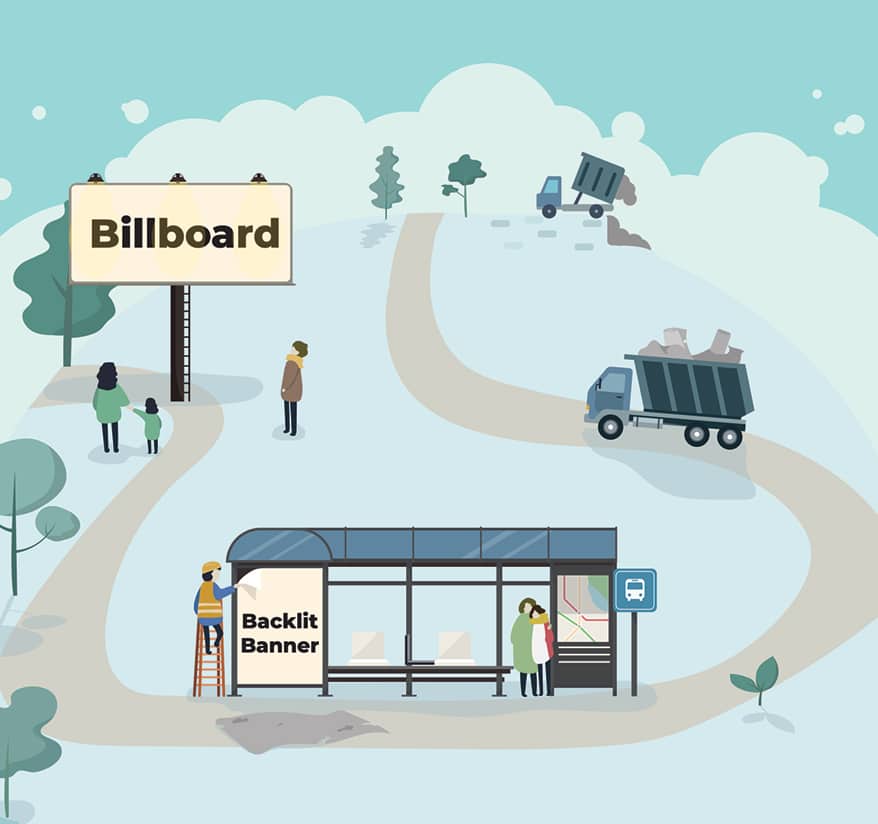
On average, most PVC banners designed for advertising and marketing are used for up to 45 days, after which most end up in landfill or are incinerated. Yet when sent to landfill, PVC takes decades to break down and can leach toxic compounds — particularly those from plasticizers such as phthalates — into the environment. If incinerated, notoriously hard-to-monitor carcinogenic compounds such as dioxins and furans can be emitted into the air, while the fly ash resulting from burning PVC also is toxic and thus needs to be carefully disposed of. (And this is before you consider the horrifying levels of toxicity being released into the environments of numerous American communities through the production of PVC.)
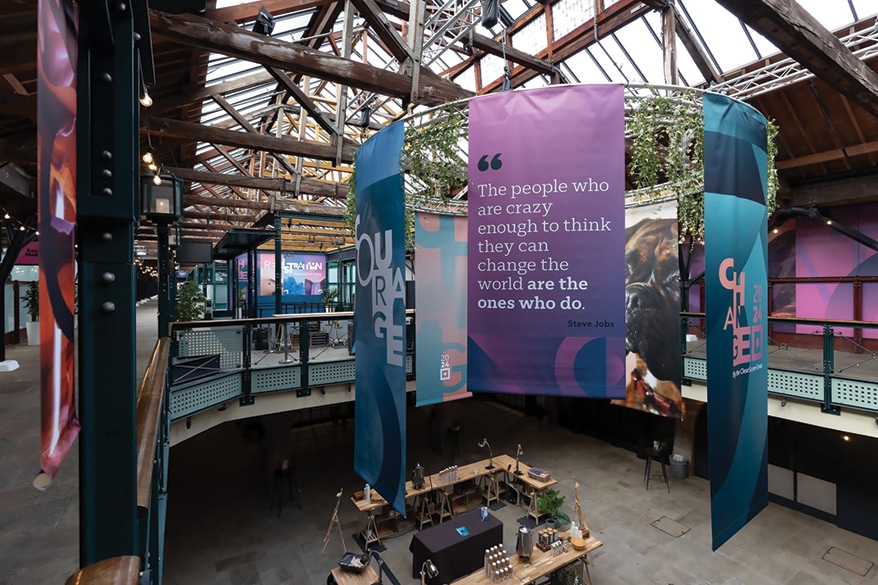
PHOTO: MOSS UK AND PROVIBER PRODUCTIONS
With recent research by Big Picture magazine and Keypoint Intelligence having found that seven out of the top 10 wide-format print applications by volume are produced on flexible substrates, end-of-life disposal of PVC banners is not an issue that the industry can afford to ignore.
The growth in performance and cost effectiveness of PVC-free banner materials means that, for many wide-format print and signage businesses, reduction and replacement of harmful materials now are two sides of the same coin.
Can’t We Just Recycle?
Unfortunately, no PVC-based signage materials are suitable for closed-loop recycling, whereby materials are converted back into the same product. This is because PVC banners are composite materials typically manufactured by laminating polyester fabric between two layers of PVC resin. This means they include a combination of calcium carbonate, PVC resin (usually around 33%), polyester fabric, and plasticizers.
Technological advances in mechanical recycling mean that it now is theoretically possible for PVC film in banners to be separated from the polyester fabric and then used in the production of new products. However, this possibility does come with its own environmental challenges in terms of energy use. In addition, although some research suggests that PVC banner materials could be ‘upcycled’ into new materials such as bags and clothing through open-loop recycling programs, previous attempts to upcycle PVC have failed due to significantly exceeding REACH and other chemical standards. Moreover, upcycled products still ultimately would find their way back into the waste stream and thus into landfill.
Advertisement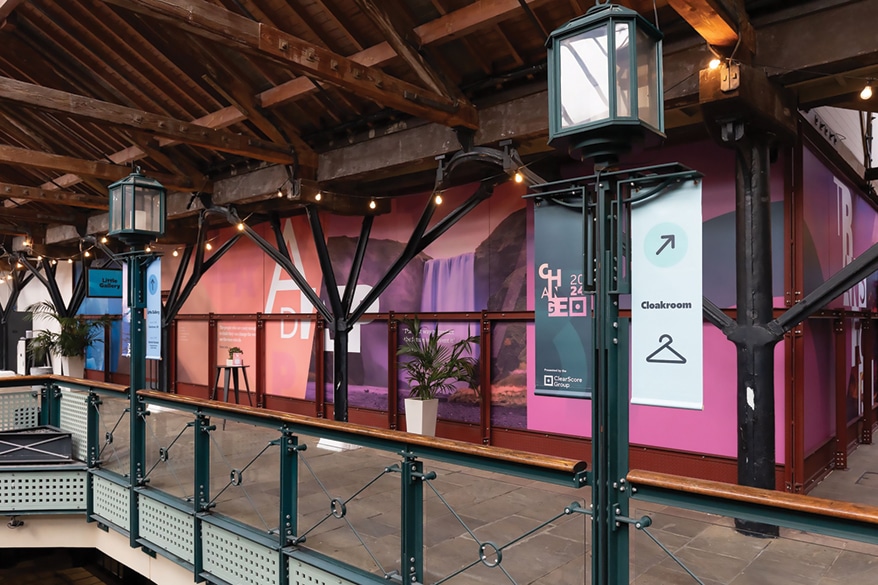
As an industry, we need to find ways to reduce our overall consumption and ensure that the materials we do consume are less toxic. PHOTO: MOSS UK AND PROVIBER PRODUCTIONS
Reduce, Reuse and Replace
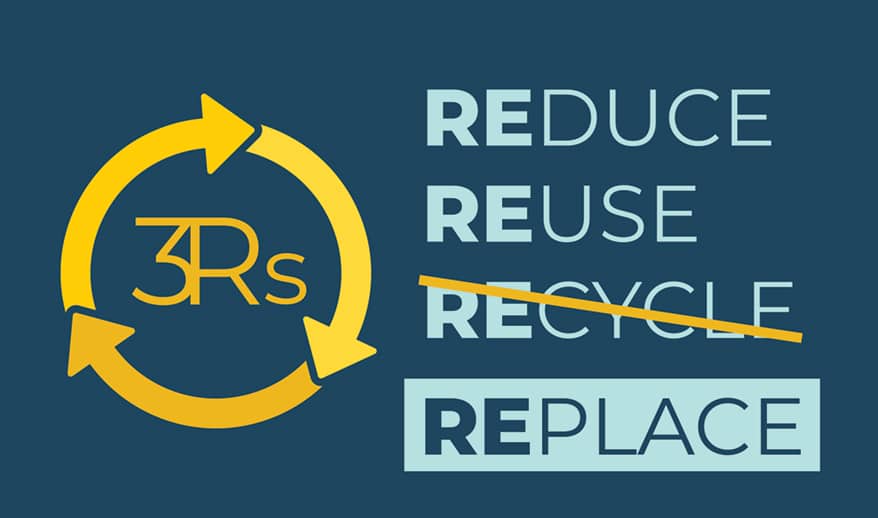
While the origin of what are often referred to as “The Three R’s — reduce, reuse and recycle — is a matter for debate, their simplicity means that most waste minimization strategies can be distilled to these concepts. As we’ve already seen, recycling is not an option for PVC-based signage materials, which leaves many responsible businesses in the wide-format and signage industries looking for ways to reduce or reuse them.
The entire industry could take a lesson from the words of American folk singer and activist Pete Seeger, who sang, “If it can’t be reduced, reused, repaired, rebuilt, refurbished, refinished, resold, recycled, or composted, then it should be restricted, redesigned, or removed from production.”
As an industry, we need to find ways to reduce our overall resource consumption and ensure that the materials we do consume are less toxic. But how can you achieve this if you’re in the business of producing signage for customers? The answer is threefold: reduction of harmful materials such as PVC; working with customers to create solutions that they can reuse where suitable; and finally, replacing harmful materials with ones that have a lower environmental impact, such as PVC-free banner materials.
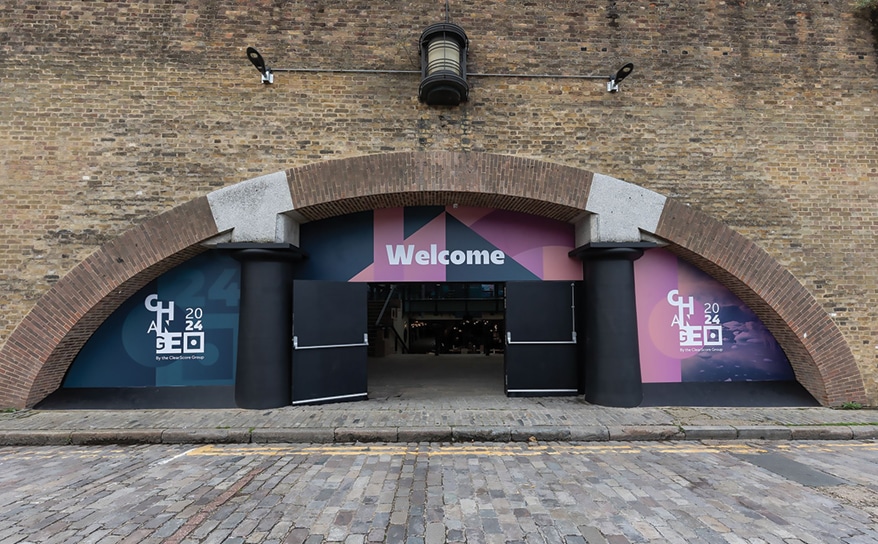
PHOTO: MOSS UK AND PROVIBER PRODUCTIONS
The growth in performance and cost effectiveness of PVC-free banner materials means that, for many wide-format print and signage businesses, reduction and replacement of harmful materials now are two sides of the same coin. When it comes to flexibility, tensile strength, tear resistance, and weldability, PVC-free materials can now match those offered by traditional PVC, but with a lower weight and none of the toxicity.
When it comes to reuse, while it may seem counterintuitive to recommend that customers explore ways to extend the lifespan of their display graphics, doing so can pay dividends in terms of both upselling potential and the possibility of developing a more consultative customer relationship.
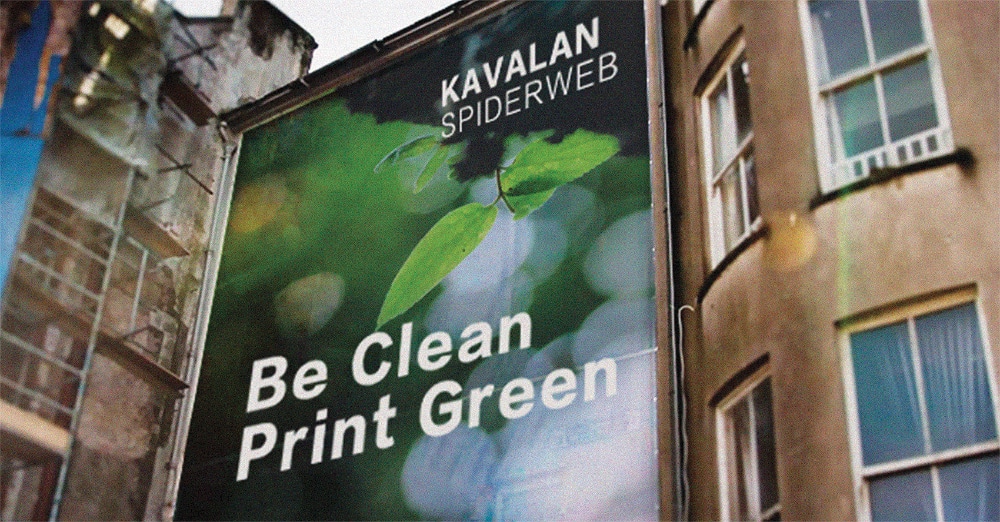
On average, most PVC banners designed for advertising and marketing are used for up to 45 days, after which most end up in landfill or are incinerated. PHOTO: KAVALAN
A Life-Cycle Management Approach
As a business owner, you cannot achieve sustainability by ticking a few boxes, slapping some green credentials on your website, and shouting about how “green” your shop is. It is only through making decisions informed by a thorough understanding of all of your business’ environmental impacts, from the materials you choose to how they are disposed of, that you can truly begin to minimize your impact and operate more sustainably.
Building a holistic view of the different ways your business impacts on the environment, both locally and globally, is understandably complex. However, by adopting three core principles, you quickly will begin to identify areas for improvement:
- Scrutinize supply chains and sourcing:
Nearly every month, one brand or another finds its way into the press for the wrong reasons, serving as a reminder to business owners that if you don’t scrutinize your supply chain, someone else will. And with growing numbers of businesses in every industry introspecting on their sourcing policies and overall sustainability, you can be sure that many wide-format print buyers are doing just that. But there’s more to it than just making sure you look for the evidence behind your suppliers’ claims and ensuring that you understand what you are buying when sourcing materials and consumables. Many businesses throughout the industry could benefit from reassessing their supply chains through a lens of sustainability to identify areas for iterative improvement, including end-of-life disposal. - Demand the data on disposal:
Have you seen the evidence that your suppliers use to back up their claims or do you just take them at face value? If a business doesn’t have verifiable data to support its environmental credentials, you can’t be certain that it’s valid. When a waste management company claims that it will recycle PVC banner materials, do you know what that actually means? When you throw away used materials, are you sure you know where “away” is and, just as importantly, do your customers? - Learn from a Life Cycle Analysis:
Usually conducted by an independent third party, a Life Cycle Analysis (LCA) evaluates the environmental impacts of a product from production and consumption to disposal. This includes analysis of sourcing and processing raw materials, the processes involved in manufacturing and production, how products are transported and distributed, how they are used and, ultimately, how they are disposed of. Because they provide quantifiable data, LCAs can be an excellent starting point from which to build achievable sustainability strategies.
Just as no brand would want to see images of their building wraps or banners languishing in a landfill, no print business should be willing to accept that this is the ultimate fate of their hard-earned work. If we can’t recycle or reuse what we produce, it’s time we find ways to reduce it, replace it, or rethink it. Ultimately, the best way to dispose of PVC banner waste is not to produce it in the first place.
PHOTO GALLERY (6 IMAGES)
PHOTOS: KAVALAN | MOSS UK AND PROVIBER PRODUCTIONS














How to Turn Small Orders Into Big Office Branding Projects

The Big Ink Tank Drives Up Capacity and Confidence With Anapurna Ciervo H3200 From Agfa

Roland DGA Announces Launch of New UV DTF System with Enhanced Media



Bulletins
Get the most important news and business ideas from Big Picture magazine’s news bulletin.
-

 Business Growth: Mark Coudray4 weeks ago
The Hidden Danger of Running a ‘Successful’ Business
-

 TIp Sheet1 month ago
The Two-Hour Rule, the Pet Frog Close, and 7 More Ways for Print Pros to Work Smarter
-

 Sales Strategies: Kevin Baumgart1 month ago
5 Simple Ways to Add Value (and Revenue) to Every Order
-

 TIp Sheet1 month ago
Stop the Pep Talks, Start the Stories: 5 More Tips for Wide-Format Print Pros
-

 Case Studies1 month ago
Wrap Challenges: How 4 Print Pros Tackled Their Toughest Projects
-
 Tips and How To3 weeks ago
Fleet Sizes Are Up. So Are Client Expectations. Here’s How One Shop Owner Keeps Pace.
-

 Press Releases1 month ago
Epson to Debut New Textile Solution at Impressions Expo Long Beach 2026
-
 Wide Angle3 days ago
How to Turn Small Orders Into Big Office Branding Projects