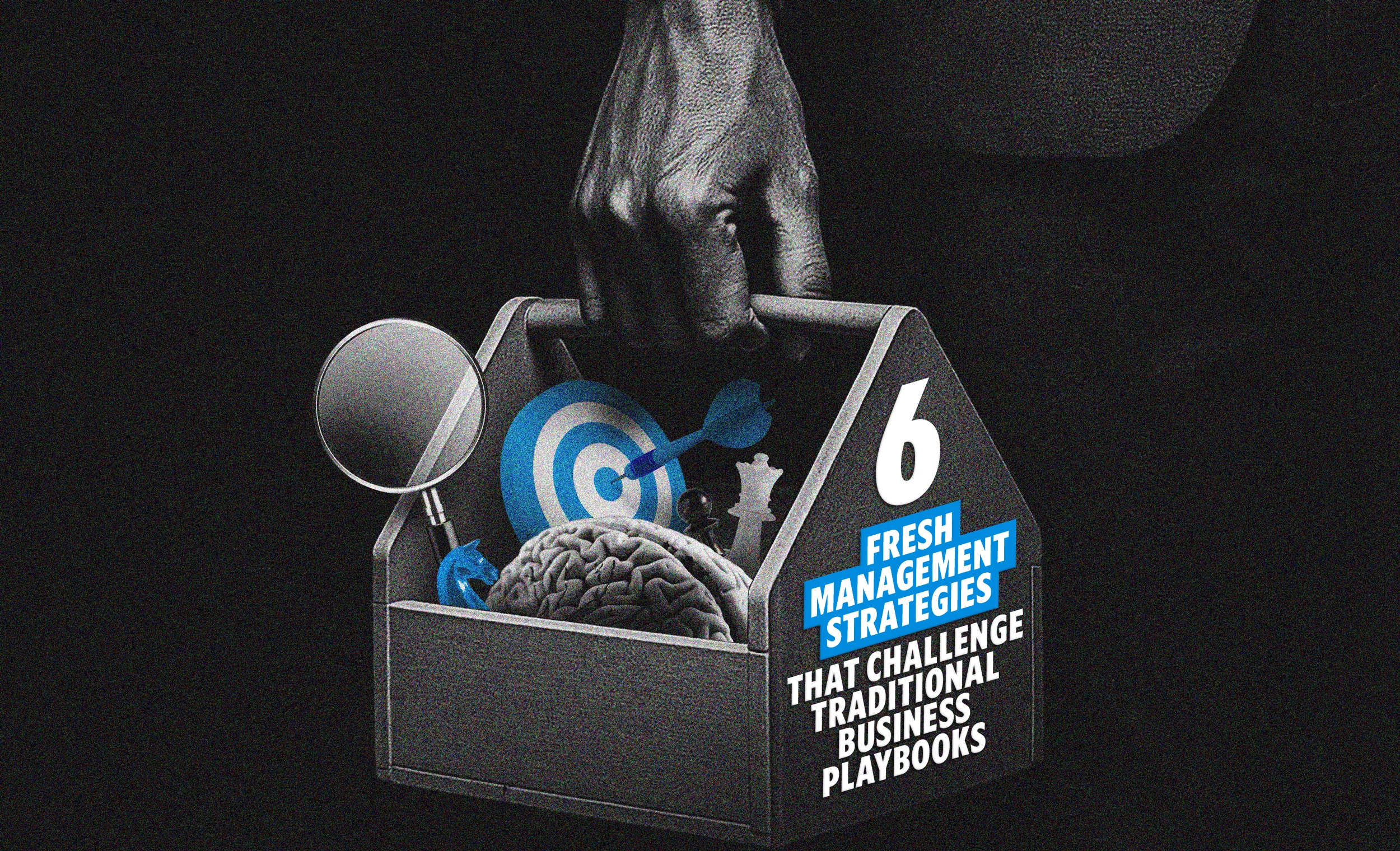
The Alternative Manager’s Toolkit
From ditching the 5-year plan to embracing your gut, sometimes the counterintuitive move is the right one.

THERE’S MUCH TO BE said for best practice and convention. Their effectiveness has been tested by time and the marketplace. But in business management there’s not just one correct answer. Many paths can lead to accomplishment and the less trodden route can boost your chances of success. Thus, we present our Alternative Manager’s Toolkit for those feeling that the normal way of doing things is getting stale. If there’s a common thread in the methodology, it’s that an understanding that we are all a little different and bring our own unique strengths to managing our lives and business. Success lies in fully tapping those talents — especially in a world that refuses to stand still. In the following pages we present nine challenges that confront business owners and managers. We discuss the usual way of doing things, alternate strategies, and tips to implement each approach. Enjoy the story, and possibly the new path it takes you on!

Challenge/Task: Goal Setting
Traditional Playbook: Most business owners sit down at the start of a new year and craft beautiful, intricate plans that may include ambitious targets, vast spreadsheets and rigid timelines. Their hope is that clear goals will direct energy and keep everyone accountable.
The Problem: You only have to look back as far as the collapse of the Soviet empire to appreciate central planning’s patchy record. The real world rarely likes to play along with our expectations. Rigid goals can become obstacles rather than motivators. When circumstances shift and teams feel boxed in, your workers get demoralized or disengage. If progress isn’t obvious, momentum slows. Those audacious goals suddenly seem unrealistic, leading to a sense of failure before the year has barely begun. Compare the traditional approach with the insight of Stephen Shapiro, whose book “Goal-Free Living” makes the case that you can have direction without obsessing about the destination. “Opportunity knocks often, but sometimes softly,” he says. “While blindly pursuing our goals, we often miss unexpected and wonderful possibilities.”
The Alternative Manager’s Fix: Ditch the 5-year plan. Embrace uncertainty. Adopt a “ready, fire, aim” mentality — launch small initiatives quickly, learn from immediate results, and adjust course accordingly. This agile philosophy prioritizes progress over prediction and learning over forecasting.
How to Make It Happen
- Replace fixed targets with adaptive milestones that guide teams without chaining their hands. This enables a “ready, fire, aim” mentality that favors launching quick modest initiatives to learn from real-world feedback before adjusting course.
- Instead of that “Big Hairy Audacious Goal”, opt for a really stimulating vague goal, like “foster a kickass company culture”. Through the year, spend time working on this goal but don’t measure your progress towards it. Just follow your vision and go with the flow.
- Focus on achieving fast small wins along the way to build confidence and momentum; aim to launch or test something within days or weeks. Create an environment where continuous improvement feels more like a flow than a rigid sprint.
- Such an experimental approach naturally requires a shift in focus from distant outcome goals to immediate process goals. “Your goal has to be the process because you do not control the outcome,” says Maria Konnikova in “The Biggest Bluff”, adding “If you put yourself in a position to win you’ve done your job. Whatever happens next, happens.”
- Regularly review and recalibrate; don’t wait until the end of the year to re-evaluate.
- Use visual cues, like progress bars or team dashboards, to subtly motivate consistent effort and maintain focus without the pressure of strict deadlines.
- Celebrate small wins frequently to build psychological momentum, maintain high levels of engagement, and reinforce that culture of continuous progress.
- Prioritize quick experimentation and learning—or “ooching” (taking tiny low-risk steps to test an idea)—over a slow, perfectionist approach, allowing you to gather real-world data quickly and reduce the risk of investing in flawed long-range plans. (More on this later)
- Remember New Coke. Maybe do nothing for a year. Many business owners tend to think that doing something is better than doing nothing, and that activity equates with productivity. But often the best thing to do is to do nothing, says Annie Duke in “Quit: The Power of Knowing When to Walk Away”. “But it has to be a choice. It can’t be because of inertia or because you’re scared or because you don’t know what to do.”
The Takeaway
To be sure, some planning is necessary — even a bad plan provides a feedback loop, experimentation and revision. Just don’t spend hundreds of hours trying to account for eventualities that are unlikely to materialize.

Challenge/Task: Exceptional Customer Service
Traditional Playbook: Many print shop owners aim to impress and attract customers with highly personalized interactions, uncommon levels of attention and service, and just generally going above and beyond — sending thank-you notes, offering extensive support, or providing free drinks and cookies or the chance to watch the big game on their inhouse monitor. The goal is to create memorable experiences that craft loyalty and positive word-of-mouth.
The Problem: Exceptional service can be costly, inconsistent, and is sometimes unsustainable, especially for small businesses. Over-investing in customer service can also lead to inefficiencies, delays, or overly complex protocols that slow everything down. Moreover, it can set unrealistic expectations that are hard to maintain long term.
The Alternative Manager’s Fix: Instead of striving for “exceptional” in the traditional sense, focus on removing friction, both physical and psychological, so that every interaction is so smooth and effortless that customers feel pleased simply by the ease of the experience. The goal is to create a pain-free shopping journey that encourages repeat business without needing extraordinary gestures.
How to Make It Happen
- Start by mapping the customer journey to identify pain points and eliminate them. (Are the best parking spots reserved for customers? Does your website allow customers to book appointments? Do you email or text updates to customers?)
- Update the buying experience. This could include online proofing portals, emailing mockups for approval before production, virtual consultations for large-format projects, and video calls to review color samples or material options.
- Use technology — auto-fill forms, chatbots, self-service portals — to make interactions easier.
- Every customer starts their journey on your website. It should be where your friction-free journey starts too. Provide live job tracking, client dashboards, AI autoresponders, and be ultra-transparent about warranties, policies and prices.
- Work to your customer’s clock, meaning being willing to work outside of conventional business hours and do on-location consultations.
- Streamline the checkout process—minimize steps, eliminate unnecessary questions, consider tablets to close the sale on the production floor or at trade shows.
- Shorten wait periods for responses, deliveries, or assistance however possible.
- Manage expectations: Better to have a reputation as a print shop that reliably delivers rush jobs in 48 hours than one that promises same-day turnaround, but with hit-or-miss results. If you do the latter, you’ll be seen as underperforming.
The Takeaway
Such service is still “exceptional”, it just doesn’t mean doing more; it means doing less that gets in the customer’s way. A friction-free shopping experience can build loyalty and satisfaction more reliably than traditional “wow” moments.

Challenge/Task: Making Smart Decisions
Traditional Playbook: Most business advice promotes conducting research, doing a thorough analysis, and relying on the “data” to make decisions. It’s about turning to reports, metrics, market studies and weighing the pros and cons to ensure choices are rational and risks are minimized.
The Problem: While logical and prudent, this approach can be slow and overly analytical, resulting in “paralysis by analysis”. It can also leave you exposed to being blindsided as a result of narrow framing, overconfidence, biases like confirmation and recency. End result, your agonized decision-making process may have made it feel like you were weighing the pros and cons, but really you were essentially taking a stab in the dark because of all the unknowables. Moreover, an over-reliance on facts means you overlooked valuable intuition or subconscious insights.
The Alternative Manager’s Fix: There’s growing evidence we only use a tiny fraction of our mental/physical capabilities. Think about that time you were focused on a conversation in a noisy, crowded room and through the din you somehow heard your name mentioned in a distant corner. How did that happen? Analytical thinking is good. But unlocking the mostly untapped potential of our “extended mind” – our right brain and gut – could result in a significant boost for mental processing power. The idea is not to be irrational and impulsive but to use these intuitive signals to complement your rational analysis, making decisions more agile and aligned with real-world nuances.
How to Make It Happen
- Get in touch with your “extended mind”. In her book of the same name, Annie Murphy Paul recommends keeping an “interoceptive journal” to note how your body felt when making a decision. She cites studies of Wall Street traders who seem to make more money when they’re better at reading their own body signals, hunters who pick up environmental cues, and doctors whose own body reactions can help in diagnosing patients.
- Practice rapid decision-making in small scenarios to build confidence in trusting your instincts and experience. (Most decisions, whether it’s looking at a menu or choosing a new brand of toilet paper for your store bathroom shouldn’t take more than 15 minutes.)
- In particular, try to reconnect and learn from emotions that have historically been labeled as negative and see them as signals and sources of information. “Instead of trying to repress them, if we listen to them, they can be very helpful in informing our decisions,” says Anna-Marie Cunff a neuroscientist and author of “Little Experiments”.
- Humans’ more developed prefrontal cortex – which is responsible for planning and emotion control — is one of the key features that sets us apart from other species. But when it comes to creative thinking, it’s the deeper parts of our brain – the subconscious – that may be the real supercomputer. Yet to bring the subconscious into action usually requires taking a break from worrying about the problem at hand. “Living in that problem space and falling in love with your problems is one of the most powerful ways to unlock really innovative solutions,” says Stanford business professor Tina Selig.
- Reflect on past decisions. When did your gut prove reliable, and when did it mislead you? Use these lessons to refine your judgment.
- Ascertain whether an issue is one better suited for analysis or intuition? “If it’s a decision that’s recurring, and amenable to improvement, you should invest in gathering data, doing analysis, and examining failure factors,” says Babson College professor Tom Davenport, author of “Thinking for a Living.” “[Otherwise,] you might as well go with your experience and intuition.”
- There are many caveats here: the reason the gut is so effective is that it simplifies stories while still incorporating deep-seated subconscious activity. But be aware of biases—question whether your gut is being influenced by recent experiences, emotions, or just lazy assumptions.
The Takeaway
Smart decision-making isn’t only about cold facts; it’s about leveraging all your faculties—analysis, intuition, and subconscious insights—carefully balanced. Trust your instincts, but keep your biases in check, and you’ll make quicker, more authentic and often better choices.

Challenge/Task: Problem Solving
Traditional Playbook: Most managers believe that providing ample resources — money, tools, time, or personnel — is the best way to solve problems.
The Problem: There’s a saying in business that if you have enough money to fix a problem, you don’t have a genuine problem – you have a resource allocation issue. Sometimes, too many resources can dilute focus or encourage spending rather than innovation. Money is also rarely the answer to systemic or long-term issues like cultural problems or ensuring your business’s long-term viability. “Real” problems like process re-engineering or a strategic pivot often require innovative solutions beyond funding.
The Alternative Manager’s Fix: Use artificial constraints — deliberately impose limits on time, budget, or scope — to drive creativity and resourcefulness. Constraints spark innovation by forcing teams to think differently, prioritize ruthlessly, and come up with clever solutions within tight parameters, often more effective than simply throwing resources at a problem. Behind all this is the counterintuitive insight that discipline and structure are often the path to freedom, not its enemy.
How to Make It Happen
- Limit budget or parameters intentionally, encouraging creative solutions to do more with less. In an essay “17 Questions That Changed My Life”, Tim Ferriss writes: “The question I found most helpful was, ‘If I could only work two hours per week on my business, what would I do?’ Honestly speaking, it was more like, ‘I know it’s impossible, but if I … had to limit work to two hours per week, what would I do to keep things afloat?’” Confronted with such a constraint, you may be surprised at the ideas you come up with.
- Limit decision options: Restrict the number of choices available during planning or design to force prioritization and creativity. Create “rules of the game” that restrict the tools or resources that can be used to prompt out of the box thinking.
- Use random constraints or inputs: Introduce unpredictable elements like specific materials or themes to stimulate novel ideas.
- Apply the “Inverse Thinking” technique: Pose questions like, “What if I couldn’t do the obvious solution?” to discover unconventional approaches.
- Encourage cross-disciplinary thinking: Borrow ideas from other industries. How would a packaging company approach this job? A gallery? An event planner? Fresh angles often come from outside your usual frame of reference.”
- Frame constraints as a game. Not only are games about fun, but they are distinguished by the rules that govern them. And about winning.
The Takeaway
Embrace “golden handcuffs”. They work in music, art, sport, government policy — any field requiring a creative response. Artificial limits force teams to think creatively, prioritize, and discover solutions faster and more resourcefully than relying on abundance.

Challenge/Task: Influencing Your Team
Traditional Playbook: Most bosses rely on bonuses, awards, or inspirational pep talks to inspire employees. It’s all about carrots and sticks — throwing rewards at the goal or rallying the troops with grand speeches.
The Problem: Rewards can be expensive and encourage short-term thinking or unhealthy competition. Pep talks may spark excitement, but rarely sustain motivation in the long run. Emotions are, by definition, temporary.
The Alternative Manager’s Fix: Nudges. What if instead of pushing from outside, you gently guide your team’s behavior with clever subtle cues? Think of nudges as tiny prompts designed to steer people toward better habits — without forcing or fussing. This method taps into how humans actually make decisions, making motivation feel almost effortless.
How to Make It Happen
- The most successful example of nudges is “defaults”. People defaulted into pension plans, two-sided printing, or renewable energy for their home tend to stick with it. In the workplace, an example would be automatically enrolling staff in a development or training program at certain points in their tenure, so growth becomes a no-brain decision.
- “Salience” is something that most savvy print shop owners know well – like displaying finished samples of high-margin services prominently in the front office or putting your most impressive large-format work where clients can’t miss it. In the staff room, grabbing a ceramic cup conveniently stacked next to the coffee machine instead of a paper one from the cupboard does not require your workers to think about saving the rainforest before their morning coffee. The less conscious the nudges are the less they are prone to wearing off or even backfiring, regardless of whether the individual agrees with the goal of the nudge or not.
- Make teamwork the easy option — place shared tools or team goals front and center.
- Ordering and docs: Put preferred actions or upsells first in checklists and UIs.
- Dashboards as defaults: Make shared dashboards the homepage. When your team logs in and sees jobs completed, delivery rates, and targets, those metrics stay top of mind—no reminder emails needed.
- Employ public recognition by celebrating wins to inspire everyone else to follow suit.
- Use social norms to boost accountability. For example, emails that state “85% of your peers completed X” are a proven way to increase participation.
- Public commitment boards: a visible tracker of team goals (sales, safety checks, learning hours). Pair with weekly shout-outs.
- Burn your boats. Or in our case, take a long leave from the store so you can get a proper restorative vacation. It forces you to put systems and policies in place, ditch ad-hoc email-based triage, empower other people with rules and tools, and otherwise create a machine that doesn’t require you to be behind the driver’s wheel 24/7. Once in place, such systems will likely stick.
- Use “sludges”. Sometimes friction is good (think speed bumps or beeping seatbelts). At work, you may want to set limitations to how quickly money is disbursed. Sometimes, you want your employees to resist impulsive or instinctive moves. “To do creative work right, teams need to slow down, struggle, and develop a lot of bad ideas to find a rare good one,” Stanford business school professors Robert Sutton and Huggy Rao write in their recent book, “The Friction Project: How Smart Leaders Make the Right Things Easier and the Wrong Things Harder”.
The Takeaway
The best nudges – be they a process, a habit or even a culture — take thinking and motivation out of the equation. That is not to say there is no place for inspiring words. But motivation is what gets you started. A well-constructed nudge – be it from the surrounding environment, a habit, or something cultural or moral — is what keeps the change going.

Challenge/Task: Finding the Next Big Opportunity
Traditional Playbook: Many business owners rely on scanning industry trends, reading the business news, conducting SWOT analyses, attending conferences at trade shows, or following market reports to find new opportunities. The focus is on analyzing data, competitive positioning, and strategic planning to find the “next big thing.”
The Problem: Over-reliance on trend-spotting and formal analyses may cause you to overlook opportunities right in front of you—those that can be unlocked by genuine curiosity or personal passion. The business school approach can lead to you to chase shiny objects that aren’t aligned with your core strengths or values, resulting in missed chances or scattered efforts.
The Alternative Manager’s Fix: Follow your curiosity. Embrace the mindset advocated by the tech investor Paul Graham of exploring ideas and questions that genuinely fascinate you. Rather than trying to predict what others will do, pursue what intrigues you, experiment intuitively, and see where your passions lead. Innovation emerges naturally when you are curious and attentive to what excites you. And it’s not just business opportunities. Curiosity can lead you to explore new technologies, new work processes, or totally un-related fields. It may just rekindle your enthusiasm in your current business should it happen to be flagging.taps into how humans actually make decisions, making motivation feel almost effortless.
How to Make It Happen
- Dedicate time on a weekly basis to “idea shopping” based on your interests and questions: What do you naturally wonder about? “Notice gaps, explore promising ones. This is how practically everyone who’s done great work has done it, from painters to physicists,” says Graham in his essay “How to Do Great Work.”
- Pay attention to your personal interests and where your energy flows; these are often clues to unexplored market opportunities. “What are you excessively curious about — curious to a degree that would bore most other people? That’s what you’re looking for,” says Graham.
- Try asking yourself: If you were going to take a break from “serious” work to work on something just because it would be really interesting, what would you do? “The answer is probably more important than it seems,” Graham says.
- Be open to serendipity — follow tangents in your work, conversations, and reading. A chance comment from a customer or a material you stumble across at a trade show could be the spark that ignites your next big service offering.
- There is an important caveat. This is not a recommendation to become a dilettante or to spread yourself too thin pursuing many projects. But if you’re looking for the next big thing – and aren’t we all – then an approach based on what excites your curiosity may well be the best path to success.
The Takeaway
Finding opportunities isn’t just about analyzing external signals—sometimes, the best ideas come from simply following your curiosity. Trust your inner explorer, experiment boldly, and you might discover opportunities others overlook, all fueled by authentic passion and genuine interest.

Challenge/Task: Getting Things Done
Traditional Playbook: Most business owners and managers believe that to be productive, they must grind through long hours, hustle relentlessly, and stay busy. This “long work” approach emphasizes diligence, persistence, and sheer effort — often equating busyness with productivity.
The Problem: Burnout, reduced focus, and diminishing returns are common outcomes of relentless grind. Long hours can lead to fatigue and sloppy work, while the underlying productivity may suffer. Moreover, staying busy doesn’t necessarily mean you’re working on the right things or making meaningful progress. Indeed, it’s not uncommon for people to use being busy as a ruse to actually avoid critically important but uncomfortable actions that would make a real difference.
The Alternative Manager’s Fix: Rather than associating being busy with being productive, adopt the mindset that busyness can be lazy thinking. Focus on smart work — prioritizing high-impact tasks, eliminating distractions, and working efficiently. Being strategically mindful and avoiding indiscriminate action leads to faster, more effective results with less wasted effort.
AdvertisementHow to Make It Happen
- Practice radical prioritization: identify the few tasks – maybe pick just one — that will have the greatest impact and focus on them. The pioneering management guru Peter Drucker suggested the best way to do this was by constantly asking yourself the question “What’s the most important thing for me to be doing right now?”
- Embrace the mindset that true productivity is about focused, deliberate effort, not endless hours.
- Limit your working hours—quality over quantity—so each hour counts more. One easy way to do it is to erase a day from your schedule. Don’t pencil in anything for Fridays. (Don’t worry, you’ll still be busy on Friday)
- Schedule focused time blocks—avoid multitasking and minimize distractions (meaning put your phone out of reach!!!) during important work. Let your staff know, when the door to your office is closed, it means “Do not disturb.”
- Lighten up. There is much evidence that levity supports a better workplace – it encourages people to take risks, come up with more imaginative ideas, while happy staff are more productive, healthier and less likely to leave.
- Running around in what appears to be a hyper-productive whirl looks impressive but it’s usually self-defeating. You tire yourself out, resulting in work that needs to be done over, or in little getting done the following day. Ironically, the more time you give yourself to do individual tasks, the more things you will strike off your to-do list, says Elizabeth Grace Saunders, a time coach and author of “The 3 Secrets to Effective Time Investment: Achieve More Success With Less Stress.” It was an approach Pablo Picasso, who got a bit done in his life, endorsed: “You must always work not just within, but below your means. If you can handle three elements, handle only two… In that way, the ones you do handle, you handle with more ease, more mastery, and you create a feeling of strength in reserve.”
- Get the rest you need. Ironically, while hustle culture would have you believe that every hour and minute of our time should be put to good use – if not at work, then in self-improvement – it’s actually false. Our bodies are like a farmer’s fields — to reap the best harvest, they need fallow periods too.
The Takeaway
Forced by the pandemic to stop and look around, many people realized hustle culture, leaning in and girlbossing weren’t such great ways to live. And besides, more deliberate effort yields better results and preserves energy. Less busywork, more impactful work, accepting the limitations of our minds and bodies—that’s the real secret to getting things done.

Challenge/Task: Focus
Traditional Playbook: Most print shop owners are stout believers in keeping it focused — knowing their niche, perfecting what they do best, streamlining operations, and sticking to proven territory. This “laser-like” approach is seen as essential for success and avoiding the dilution of your attention and resources on less important areas. Anything else, it’s feared, could lead to damaging mediocrity.
The Problem: While focused effort can indeed lead to mastery, it can also blind you to new opportunities. Over-focusing on your core might cause you to miss emerging trends, innovative ideas, or adjacent markets that could unlock new growth. It risks stagnation in a rapidly changing landscape. (Think Kodak, Blockbuster, Nokia — or the traditional sign shop that ignored digital printing.) Also, we’re wired to appreciate the novel. Without learning new things and being exposed to fresh experiences, life can become pretty dull.
The Alternative Manager’s Fix: Instead of solely honing your core, adopt a mindset of continuous experimentation — small, low-stakes tests that allow you to explore new directions and see where they might lead. Running deliberate, quick experiments isn’t about abandoning focus but about being open and adaptable, allowing your business to evolve and discover new opportunities organically. Living experimentally and with curiosity is also an inherently fulfilling way to live.
How to Make It Happen
- Set aside small investment resources for experiments outside your main area of specialty — test new ideas or markets in quick cycles.
- Encourage a culture of curiosity among staff — regularly explore “what if” scenarios and low-cost pilots.
- Use customer feedback and data from these experiments to inform whether to expand, pivot, or abandon new initiatives.
- Keep your core stable but flexible — use experiments to supplement and enhance your main business, not distract from it.
- Adopt the mindset of the scientist: It’s not a failure, it’s “data”. View setbacks as valuable learning opportunities. Analyze what went wrong and iterate.
- Leverage diverse perspectives: Involve a range of voices and disciplines in testing ideas, increasing creativity and reducing blind spots.
- A crucial question to ask yourself about experiments that don’t turn out well is, “Am I failing differently each time?” says Steven Levitt, author of the business bestseller “Freakonomics.” For all our talk here about experiments, what we are actually talking about is learning. Fail the same way over and over, and you’re clearly not learning.
- Figure out how to get out of the echo chamber to think differently (meet and befriend artists, engineers, people who see the world differently). Our pattern-seeking brains send us off on old paths, which is why social media sites like Facebook or even Amazon Books that reinforce such behavior and tastes are so dangerous. The goal is to trigger thoughts of “what if” in a field you know so well.
The Takeaway
Focus is powerful, but a mindset of curiosity and experimentation keeps your business adaptable and alive. Small, controlled experiments can reveal unexpected opportunities and accelerate innovation — turning your core strength into a platform for growth, not a boundary.

Challenge/Task: Improvement
Traditional Playbook: Most managers believe in identifying weaknesses — whether in their skills, team members, or processes — and then working hard to fix them. This often involves training, coaching, or restructuring to shore up deficiencies, with the aim of creating an all-around competent, balanced organization.
The Problem: Constantly fixing weaknesses can be draining, costly, and ultimately ineffective, because many weaknesses are hard to improve beyond mediocrity. It can also divert attention from areas where you could excel and make a real difference. Over-focusing on weaknesses can also foster a negative mindset or a sense of inadequacy among your employees and even yourself.
The Alternative Manager’s Fix: Focus on what you and your team are naturally good at — their strengths — and leverage those to drive excellence. Instead of wasting time trying to dramatically improve weaknesses, accept that some areas will remain average. Build a business based on peak strengths, where talent and passion naturally thrive, and weaknesses become less critical.
How to Make It Happen
- Identify and cultivate core strengths in yourself and your team — what do people naturally excel at? Look for signs of what they enjoy doing, pick up quickly, volunteer for and what gives them feelings of accomplishment.
- Ask yourself and your staff, What was the best day you had at work in the last two months? What were you doing? Similarly, ask, What was the worst? And make adjustments so they are doing more of what they have predilection for and less of what drains them.
- Minimize focus on fixing weaknesses — consider outsourcing, finding a technological solution, or accepting mediocrity in less critical areas.
- Use strengths-based coaching to elevate performance in key areas rather than fix everything.
- Replace traditional, backward-looking annual reviews with regular, informal conversations focused on immediate priorities, performance, and how strengths are being used and developed.
- Celebrate and amplify existing talents rather than obsessing over shortcomings.
The Takeaway
Elevated performance doesn’t come from being good at everything; it comes from leveraging your strengths. Tiger Woods was an average player from the sand. But his driving was so superior it didn’t matter – he rarely ended up in bunkers. Maybe your team’s strength is complex installations, not design. Outsource the design work and double down on what you do best. By focusing on what you and your team do best, you create a more energized, high-performance culture and avoid the trap of just average effort by trying to fix every flaw. And when it comes to yourself, you’ll likely enjoy your time in the shop more.













Why Your Print Proposals Stall (And How to Fix It Fast)

Avery Dennison Adds Mid-Tier Cast Film to Digitally Printable Portfolio

She Wanted to See All 5,000 Fonts. Then She Heard the Computer Rate.



Bulletins
Get the most important news and business ideas from Big Picture magazine's news bulletin.
-

 Special Reports + Analysis2 months ago
Does the Wide-Format Printing Industry Have an End-of-Life Disposal Problem?
-

 Business Growth: Mark Coudray1 month ago
The Hidden Danger of Running a ‘Successful’ Business
-

 TIp Sheet2 months ago
The Two-Hour Rule, the Pet Frog Close, and 7 More Ways for Print Pros to Work Smarter
-

 Sales Strategies: Kevin Baumgart1 month ago
5 Simple Ways to Add Value (and Revenue) to Every Order
-

 TIp Sheet2 months ago
Stop the Pep Talks, Start the Stories: 5 More Tips for Wide-Format Print Pros
-

 Case Studies1 month ago
Wrap Challenges: How 4 Print Pros Tackled Their Toughest Projects
-

 Tips and How To4 weeks ago
Fleet Sizes Are Up. So Are Client Expectations. Here’s How One Shop Owner Keeps Pace.
-

 Press Releases2 months ago
Epson to Debut New Textile Solution at Impressions Expo Long Beach 2026