
Eco-Solvent Printers in 2025: Speed, Quality, and Market Resilience”
Why eco-solvent printing remains a top choice in wide-format production—even as UV and latex technologies grow.

IT WASN’T LONG ago that many in the digital print industry were predicting a downturn in the demand for eco-solvent print devices as technologies like UV printing and latex printing grew their share of the market.
While the digital printing market overall is expected to grow at a healthy compound annual growth rate (CAGR) of 12.06% from 2024 to 2030 (1), the demand for eco-solvent printers also has remained robust. As a result, manufacturers are continuing to produce innovative improvements for these popular devices.

While there’s currently not a lot of growth in the eco-solvent print market, the technology continues to be a versatile and popular option for print service providers and its share of the overall market remains strong.
Roland DGA’s Manager of Digital Print Daniel Valade talked with me about how today’s eco-solvent printers are meeting and beating expectations for speed and high-quality output while holding their own in an increasingly crowded digital printing marketplace.
Q: How would you describe the market for eco-solvent printers today?
Daniel Valade: Over the past few years, the expected downturn in demand for eco-solvent technology has failed to materialize. While many users are in fact adopting or adding other ink technologies such as latex or UV printers to their production floors, the data shows there’s still a strong demand for eco-solvent roll-to-roll technology. This is due to its outstanding versatility and wide use in the industry.
Q: How are printer manufacturers responding?
D.V.: Users have let manufacturers know they want wide-gamut eco-solvent printers that can keep pace with production needs in today’s competitive print environment. And print device manufacturers are listening.
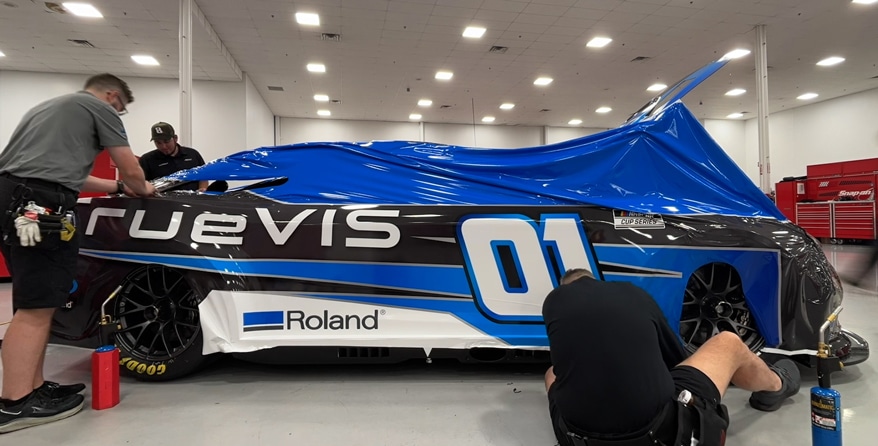
There literally are thousands of different media with specific applications that can be used on an eco-solvent printer.
Speed definitely is a factor in the latest versions of eco-solvent printer technology. Roland DG for example, has just released two new, high-productivity eco-solvent large-format devices — the TrueVIS XP-640 printer and the TrueVIS XG-640 printer/cutter. Similarly, we see other manufacturers developing new output devices that provide more production power than their past devices.

Here’s the answer to your need for speed. It’s definitely a factor in the latest versions of eco-solvent printer technology.
Manufacturers also are offering more variety in their ink sets, allowing users to choose the configuration that best suits their needs. For some shops, the production speed advantages of dual CMYK outweigh the benefits of a wide-gamut ink set, with productivity being the most important feature. Other shops value the added color range that incorporating non-CMYK inks in the ink set can provide.
Q: What about software for this market?
D.V.: RIP companies continue to strive to make very complex workflows as simple as possible to set up. Several producers even have created a simple front-end design that integrates with their RIP software. This allows for an automated and powerful workflow. Some RIP products like our XP-640 and XG-640 devices offer advanced features like True Rich Color settings that, combined with the company’s TH and TR3 ink sets, make color management easier than ever.
The other area where software is having an impact is in the user-friendliness of these advanced eco-solvent devices. The TrueVIS XP-640 printer and XG-640 printer/cutter, for example, feature a seven-inch control panel with an intuitive interface that facilitates set up.
Advertisement
As technology advances and output devices get faster there will continue to be opportunities for people to grow their businesses using their eco-solvent devices for years.
Q: Are there any developments in terms of media?
D.V.: One of the big advantages of eco-solvent printing is the wide range of compatible media options on the market. There literally are thousands of different media with specific applications that can be used on an eco-solvent printer. Users can print everything from decals, banners, indoor and outdoor signage, and vehicle wraps to window clings and perforated printable window materials quickly and easily.
Media management is also an area of focus for manufacturers. Many models include an automatic media take-up system that makes unattended printing available for today’s busy shop owners.
How are manufacturers meeting the need for wide-gamut inks?
Users are looking for more than just a traditional CMYK printer and appreciate having spot color options like orange, green, red, and white as part of their ink sets.

Eco-solvent printer users can print everything from stickers, decals, banners, indoor and outdoor signage, and vehicle wraps to window clings and perforated printable window materials.
Manufacturers are responding with ink sets that include wider varieties of ink, and that provide multiple benefits. They not only offer an incredible color gamut but also are very efficient. Most roll-to-roll eco-solvent devices, have very low running costs, averaging less than $0.20 per square foot and running as low as $0.10 per square foot.
With an expanded color gamut, users can hit previously unattainable hues and more closely replicate specific brand colors. Customers also appreciate quick turnaround times from using newer, fast-drying eco-solvent ink formulations that allow for same-day lamination or installation.

Eco-solvent printers can create visually exciting images for a variety of applications, such as backlit signage.
Q: What do you see for the future of eco-solvent production?
D.V.: While we aren’t seeing a lot of growth in the eco-solvent print market, the technology continues to be a versatile and popular option for print service providers, and its share of the overall market remains strong. As technology advances and output devices get faster there will continue to be opportunities for people to grow their businesses using their eco-solvent devices for years.
That said, latex ink printers and UV ink printers are growing their market sizes, due in part to these technologies providing the opportunity for instant lamination and same-day shipping or installation. Inkjet manufacturers recognize that they will need to continue to innovate their eco-solvent production equipment to keep pace with the changes in the marketplace.
Advertisement








Fleet Sizes Are Up. So Are Client Expectations. Here’s How One Shop Owner Keeps Pace.

13 Tips to Remember From Our Jan-Feb Edition

MUTOH America Launches HydrAton 1642 With AQUAFUZE Ink Technology



Bulletins
Get the most important news and business ideas from Big Picture magazine's news bulletin.
-

 Business Management2 months ago
How Your Business Can Earn Profits With ADA Signage
-

 How To1 month ago
Does the Wide-Format Printing Industry Have an End-of-Life Disposal Problem?
-

 Business Growth: Mark Coudray2 weeks ago
The Hidden Danger of Running a ‘Successful’ Business
-

 TIp Sheet1 month ago
The Two-Hour Rule, the Pet Frog Close, and 7 More Ways for Print Pros to Work Smarter
-

 Sales Strategies: Kevin Baumgart3 weeks ago
5 Simple Ways to Add Value (and Revenue) to Every Order
-

 TIp Sheet1 month ago
Stop the Pep Talks, Start the Stories: 5 More Tips for Wide-Format Print Pros
-

 Case Studies2 weeks ago
Wrap Challenges: How 4 Print Pros Tackled Their Toughest Projects
-
 How To5 days ago
Fleet Sizes Are Up. So Are Client Expectations. Here’s How One Shop Owner Keeps Pace.